Showing posts with label Seniors. Show all posts

Thursday, October 1, 2026

Remembering Janet

My sister, Janet, passed away on Wednesday, September 30, 2026. She was the ultimate big sister, always caring, always responsible.

Although she lived three states away, Janet routinely made time to come see Mom and Mom's sister, Aunt Louise in Texas.

She would come over to my house across the street for a brief respite during her visit. We'd debrief over a glass of wine and maybe watch a favorite movie, like Overboard, the original one. 

Janet was a devout Christian, a mom, a sister, a daughter, a wife, a teacher, a seamstress, a quilter, a photographer, a baker, a great cook. She loved Key West and her beloved high school there where she joined the drama team and performed in plays. 

1939 Bantam Roadster

She drove the family's 1939 Bantam Roadster to school.  It was rumored to have belonged to Mrs. Ernest Hemmingway and was stored for decades, undriven, in a garage before our dad restored it and painted it her school colors. Back then it was red and white.

Janet was a stage 4 breast cancer survivor who'd been given a 6 month life expectancy in 1999. Thankfully, the Lord had better plans for her and she lived 27 more years.


1999

1999 was a tough year for her. She flew here to Dallas and then we flew together to M.D. Anderson Cancer Center for a second opinion. We ran out of gas on the way to the airport, yet, still made our flight in time. Despite the circumstances and the poor prognosis, that trip was a special time shared with my sister. 

2013 March, Janet and her husband came to visit our mother in Texas.

2015 Mom's 90th

She joined the celebration of Mom's 90th birthday in 2015.My brother had a picture book made of the event to help Mom remember her family members' names. 


Later, at a much earlier age than our mother, Janet would rely on a picture book her daughter made to help remember family names and faces.


Janet with her VW bug in the mid 1960s.

She had to grow up early to help care for her younger brother and her little sister. During my mother's convalescence after a burn injury, she commanded the household in my Dad's absence while he was away on sea duty. She cooked our meals, washed and ironed clothes, performed and assigned chores to her younger siblings and kept the house running ship shape.

Janet had a whimsical side, full of humor and joy. She loved animals, particularly her twin cats, Simon and Schuster. When Aunt Louise was no longer able to care for her cat, Sugar, Janet transported him to South Carolina and cared for him the rest of his life.

There's so much more to say but words aren't enough. I miss you, sister. 

1950

1980


1956


1988

2001

2003


2014

2012

2024

Wednesday, December 17, 2025

Gift Ideas for Seniors and Nursing Home Residents 2

Finding the perfect gift for a senior or loved one confined to a nursing home can be hard. 

Peg served as a caregiver to family members for over a decade. Here are some useful tips and things she learned in the process.

What nursing home residents want more than anything else is a visit from you. Your visit makes them feel special and valued.

If you live far away or your schedule keeps you from visiting, a useful gift is the next best thing.

What do they want? You could ask them, but their answer is usually, "I don't need anything."

In that case, here are some tried and true gift ideas they'll love.

Residents like board games to stimulate their minds and help them remember things.

Dominos, Scrabble, crossword puzzles, coloring books, card games and jigsaw puzzles are popular with seniors. 

A wreath or colorful door decoration helps residents find their room in a hallway of doors that look exactly alike. 

For mom's 90th birthday, all her children and grandchildren came from around the world to celebrate.

The pictures from that dinner made a great photo book. Everyone's names were printed below their pictures to help with remembering everyone. Photos help ease the loneliness of isolation.

Space in a resident's room is limited. Countertops are often filled with medical equipment, cosmetics, books, and other things, leaving little room for framed photos or other keepsakes.

Using wall space to display photos of loved ones, pennants from favorite teams and other familiar items can help stimulate memories.

When the days become a blur as time passes, residents enjoy having a visible way to help them keep up with the day and date. 

This changeable calendar comes with removable wood planks with writing on both sides. There are additional planks for special events like holidays and birthdays.

This could be a self-made project for a student or crafty person to make or it can be purchased online.

Finding suitable clothing can be difficult. When Aunt Louise entered the home, she was wearing pull-on tops with elastic pants. Once she became wheelchair-bound, she couldn't stand up without holding onto the handrail. Pants made life difficult.

We found dresses with a modest neckline that slips on over the head. She likes her dresses to have side pockets. They need to be machine washable and hold up to frequent washings.

A lightweight jacket with a zipper makes a great gift that can be worn year around. This machine washable jacket is a favorite that Aunt Louise wears often. Temperature can be adjusted in a private room, but the common rooms and hallways can be uncomfortably cold for seniors. While everyone else may be wearing shorts, Grandma is usually wearing a jacket.

Drawer space is limited in most facilities. The built-in dresser only had five drawers for clothing and personal items. The nightstand had two small drawers for personal items.

A set of plastic drawers for the bathroom gives extra room for personal wipes, hand towels, toothpaste, denture cups, shampoo and cosmetics.


If you play an instrument or like to sing, the residents will always gather to listen. Songs from their favorite era engage them and encourage participation.

You can also volunteer to read stories to the residents individually or in a group.

Seniors benefit from daily exercise to boost morale, increase muscle mass and improve circulation. This video shows how the residents keep the seniors actively engaged in using their hand and eye coordination as well as their upper bodies.

Here's a clip of Aunt Louise playing balloon volleyball.


Time and distance permitting, it's nice to drop in and share a meal with your senior. Stop by their favorite fast-food place and pick up take-out to enjoy with them in the lunchroom.

A visit during meal time and your company is one of the best investments you can make. For the small price, your presence will let them know they are loved and cherished.

Wishing you the best as you keep your loved ones close.


Saturday, October 4, 2025

Walker Bag and Organizer - Gift for the Mobility Impaired

Looking for a handmade gift for a friend or beloved senior? If you've used a walker you know how hard it is to carry things around.

This gift makes it easy to carry lightweight items like pens, nail clippers, cough drops, tissues, photos, eyeglasses, or the TV remote.

This project will take a few hours depending on your experience with sewing. Most of the stitches are straight lines and there aren't too many pattern pieces to cut out.

Start by asking your loved one their preferences for flowers, plaids, stripes, solids or animal prints. The fabric store is a good place to get ideas.

What You'll Need:

  • Simplicity Pattern 2300 - Try to catch a sale at the fabric store. Mine was 99 cents.
  • A good pair of sewing scissors for cutting through the thicknesses of this polyester-filled broadcloth.
  • A flat surface and good lighting. Try to set up a dedicated area for sewing that doesn't require everything to be put away after use.
  • Practically any sewing machine will do. No zig-zag stitching is required.
  • A good fabric marking pencil helps for marking the spots to be matched up. Or, a number two pencil or eyebrow pencil will work.
  • A measuring tape helps keep the pattern even on the fabric
  • Straight pins are essential.
  • Notions needed are thread, double-fold bias tape, and sew-on Velcro for the straps.

The pattern will tell you how much fabric you'll need. This pattern calls for double-sided, quilted fabric. Be sure to buy enough to match designs if you choose a fabric with stripes or a  pattern.

Remember thread, Velcro tape, and double-fold bias tape in a color that matches your fabric. If you find the fabric and pattern on sale you'll save a bundle.

Begin by ironing the pattern pieces flat using a warm setting on the iron to get out the creases and folds in the paper. It really makes things easier.

Determine the pattern pieces that you'll need and put the extras in the envelope. Cut apart pieces that are printed on the same sheet. That helps in laying the pattern on the fabric.

Turning the straps after stitching takes a little patience and a keen eye. There are optional devices to speed this task along like a heavy-duty needle or a strap turner.

For Mom's walker, an extra strap was needed on either side of the center support Instead of just one strap in the center.

After the straps are turned right side out, Velcro is added and the straps are attached to the main body of the bag. Pictured above are the top straps and the side strap that holds the organizer to the leg of the walker.

Notice how the pattern of the fabric is matched to the pattern on the bag bodice.

The most trouble I had was the lack of directions for the side straps. It took a little improvising to cover the raw edges on the strap for the leg of the walker.

Notice along the side seam where the strap extends outward from the main body. The instructions say to encase the raw edges with the bias tape. That was hard since the strap is in the way.

I cut an extra strip of double fold bias tape about two inches long to affix to the unfinished edge left after attaching the strap to the main body of the organizer.

Attaching a short piece of bias tape along the edge of the pocket insert will cover the unfinished edge.


This organizer gets a lot of interest from the residents at the nursing home and I've been asked if I would make one for them.

The cost to make the entire project is around forty dollars depending on the fabric chosen, the notions, and the cost of the pattern. It's a worthy project to bring happiness to the receiver and the giver.


Saturday, July 12, 2025

Gift Ideas for Seniors and Nursing Home Residents

Choosing a gift for a nursing home resident can seem difficult, but these ideas are sure to please your loved one.

If you ask your senior what they want for a birthday or holiday, they'll likely tell you they have everything they need. But do they? 

What your loved one wants most is you spending time with them. Whether you're sharing a meal or clipping their nails, your presence reassures them that they are valued.

If you're not able to visit for whatever reason, consider these gifts that my family members appreciated when they lived in a skilled nursing home. 

Many facilities offer a guest meal for visitors. Sitting and sharing over a meal is true quality time. If guest meals aren't available where your relative lives, you can always bring a bag lunch or a takeout meal. Ask your senior what they might like from their favorite place.

These are some of the top 10 requested gifts:

  1. Cotton socks, slippers, sweat suits, and clothing that's easy to get on and off. Avoid zippers and buttons that might be hard to unfasten.
  2. Homemade cakes, cookies, candy, individual puddings, Ensure or Boost, sugar-free food items or fast-food favorites like milkshakes.
  3. Gift certificates for the hair salon at the facility. Clean hair lifts the spirit.
  4. Audio and video recordings of their favorite songs, movies, and TV shows.
  5. Large print books, adult coloring books, or audio books.
  6. Colored pencils, paint-by-number kits, yarn and craft supplies.
  7. Office supplies like small tablets and ballpoint pens.
  8. Board games like Scrabble, dominoes, jigsaw puzzles and crossword puzzle books.
  9. Nail clippers and emery boards.
  10. Bird feeders and seed to refill them.

Limited funds? Here are some cost free activities that you can do.

  • Offer to comb or style your senior's hair.
  • Give a hand or foot massage.
  • Trim your senior's fingernails.
  • Write a letter on their behalf. Stamp, address, and mail the letter.
  • Read them a story.
  • Sing their favorite song.
  • Play a game together like Dominoes or card games. Work a puzzle together.
  • Attend an activities session with the group.
  • Join in on the stretching exercises.

Edible gifts like homemade cookies, cakes, candy, and pies are things that most residents enjoy getting. If your senior is on a restricted diet, you can customize your holiday baking to include sugar-free gifts.

If you're not a seasoned baker, choose other edible gifts like individual pudding cups, packages of peaches or pears, crackers with peanut butter or cheese, juice boxes, or wrapped candies that are easy to open.

Another welcome activity at any skilled nursing facility is the music from volunteers who perform for the residents. Sometimes they like to sing along, wave their arms, clap to the music,  nod their heads, or even get up and dance.

Personal care Items are often requested. Keep in mind that some people have allergies, so choose softly scented cologne, air fresheners, moisturizers, hand lotion, and disposable hand wipes.

Remember that caps and lids may be difficult to open. As my mother grot older, packaging became more difficult for her to manage. Items with pump dispensers or easy to open containers are a good choice.

You might need to open the box of tissues and start the first one out of the box. Tasks that are simple to youthful hands can become a nightmare for a senior who struggles with arthritis.


Hair Salon Gift Certificates

Most nursing home residents would enjoy a little pampering. A beauty salon certificate for services by the on-site cosmetologist is a blessing. Or, you can ask to use the beauty shop and give your senior a nice shampoo and gentle scalp massage. If neither of those options is available, arrange to take your loved one to a salon nearby.

Something to Keep their Mind Active

What do seniors do with their time? Many seniors enjoy looking outside. My 95-year-old aunt likes watching the birds that come and go outside her window. A bird identification book helps her know which kind of birds land on the feeder. Volunteers will usually refill the bird feeder as long as we provide the seed. 

Visiting Pets Associations

One of the best ways to provide comfort and a touch of home is to invite the Visiting Dog's Association to visit your family members. It is amazing to watch the expressions of joy when seniors make contact with a well-trained, friendly canine. Some groups bring horses to meet the residents.

Make sure to find out which residents are allergic to animals and make arrangements for medication or for them to be in another area of the building.


Volunteer to Serve As A Patient Advocate

Most facilities allow and encourage family members to attend resident wellness conferences. At these meetings, family members and patients discuss medication issues and the care your loved one is receiving. It can also bring out issues that may need attention either from the staff or from family members.

Your presence helps your loved one advocate for themselves and gives them confidence to speak out that otherwise might be lacking.

Gifts For All Occasions

It doesn't have to be a special occasion to bring a gift to your favorite senior. Whether it is a purchased present or a gift of your time and effort, your loved one will treasure these small tokens of your affection.

Thursday, June 26, 2025

Saving Memories for My Sister

Where Are You Little Girl?

The summer I turned 16, my mother and I drove from Miami, Florida to Tallahassee to see my sister. The 500 mile journey took us to the campus of Florida State University where Janet was a Freshman.

She was living in a scholarship house off campus with a dozen or so other students. Their house mother served as a chaperone and substitute mother to these young ladies during their pursuit of a college degree. They shared meals at a giant dining room table with living quarters in an historic house just a couple of blocks from school.

Janet took me with her to her classes and to the campus library, and nearby coffee shops where I played "Little Red Riding Hood" on the jukebox.

As we stood outside the student union, a friend of hers drove up in his shiny new Chevy Corvair and stopped right next to where we were standing.

He rolled down the window and I'll never forget what he did next.


Be My Love - Mario Lanza

This dangerously handsome guy, dressed to the teeth in a light blue button-down shirt with a skinny tie, the hottest styles during the 60s, reached out and took my sister's hand. Then, without any further provocation, he belted out the song in the video above with as much gusto and volume as he could produce.

Afterward, he simply drove off just as smug and confident as he'd driven up.

I asked my sister if that was her boyfriend. She said, "No, he's just a drama student who is deeply into his craft."

I never forgot that few minutes where I thought it was the most romantic thing I'd ever seen.

Janet found her first true love on that campus, but it wasn't the Mario Lanza impersonator. She and Jim got married in April of 1967 in a church wedding with flowers, a long, flowing white dress, a best man, a flower girl (my little 5 year-old cousin) and two bridesmaids including yours truly.

She probably doesn't remember either of these events now. She's suffering from early onset dementia. It's up to the rest of the family to keep her memories safe. 
That responsibility falls mostly on my niece, Janet's daughter who lives in the same town in South Carolina.

Those of us who have served as caregivers know the heavy burden that this entails. It's a complex blend of guilt and exhaustion from trying to do it all, caring for your mother while carrying a full-time job, caring for a retired spouse, a household and the daily grind of life's activities.

I admire her perseverance and fortitude. You know who your are.

Sunday, March 14, 2021

People from the 1880s - CD and Eula

When I was barely a teen, I met a couple at church who were in their 80s. C.D. and Eula Walker. I was enamored by their old fashioned way of talking, their infallible courtesy, their acceptance of our family as their own.

They had an after-church gathering at their house one Sunday and I was fascinated by the way the food was presented in fancy dishes and served buffet style from a sideboard. I remember someone asking Mrs. Walker where her husband had gotten off to. 

"He's probably at the buffet building sideboards on his plate," she answered. I wasn't sure what that meant so my dad later explained it was like having a wagon with wood rails along the side so you could pile things higher. 

We sat in their parlor on red velveteen couches with carved legs and arms. Crystal chandeliers twinkled in the dim lighting of the room as we ate our food and communed with one another.

Their house was filled with family heirlooms that looked to be from the "roaring 20s" and treasures from their travels abroad. Things they had collected mid-life when they were around 40. Mr. Walker took us on a tour of his garage where, hanging on the wall was a helmet from World War I and other mementos of days gone by. They would have been born in the 1800s around the same time as my own grandparents who lived out of state and we saw rarely. The Walkers had no children so they adopted us as a surrogate family.

I had foolishly worn my watch out to play and the band broke off. C.D. repaired it so that I could wear it like a pin attaching it to a gold Fleur de Lis broach. He presented it to me as a gift one Sunday at church. Having lived through the Great Depression, they learned to repurpose and reuse everything. Nothing was wasted.

How I wish I had thought to ask them about their lives, their travels, their experiences before it was too late.

Wednesday, March 22, 2017

5 Things to Make a Trip to the Emergency Room Easier

When the phone rang at ten pm one Sunday night, a quavery voice said, "We've had a little accident over here."
These few words can send my adrenaline pumping. The first time we got that call, we rushed over to check on Mom who said she'd fallen. She'd crawled from her living room to the bedroom to use the only working phone. The other one broke with her fall. We wondered if we should call an ambulance or just drive her to the hospital to get checked out. We made the wrong decision.

We learned the hard way that it's dangerous to move or transport an injured person. Worse, when we arrived at the emergency room there was a long wait behind others who either looked worse or had arrived by medical transport. She spent a couple of uncomfortable hours on a hard Xray table before the doctor arrived at the small town hospital. Mom was admitted with a broken hip.
Another call came before seven am the morning of New Year's Eve. Mom asked for help getting a shower explaining that she had fallen during the night. She lay on the bathroom floor until morning. The tone of her voice indicated something was very wrong. I should have called an ambulance immediately. Instead, we bundled her up against the January cold and drove her to the emergency room. Again, bad move. The hospital was operating with a skeleton crew due to the holiday. We waited in the ER eight long hours surrounded by patients who were coughing, sneezing or vomiting.
During that time, the staff would not allow Mom to have even an ice chip until the doctor examined her. When her name was finally called, the doctor launched into a lecture about the patient being seriously dehydrated and running a fever. Imagine our response.
When the time comes to go to the hospital, the arriving paramedics will ask about the patient's  medications, their allergies, and medical history before the current emergency. 
Emergency Go Bag
Ambulance drivers want to take the patient's insurance and identification cards with them on the way to the hospital. Giving them a photocopy can avoid the loss of the patient's original cards. Gathering copies of all this info in one place ahead of time can help reduce some of the stress. 
  1. Make a copy of the patient's Medical Insurance Card, front and back. It has the phone number, policy and member's identification number. Put the copy into a Go Bag dedicated for emergencies.
  2. While at the doctor before an emergency grab two of their business cards; one for your wallet and one for the Go Bag.
  3. Create a list of other important phone numbers in case your cell phone battery dies during the wait. You'll want the numbers for their doctors, their minister, out-of-town relatives, friends and neighbors who might be concerned.
  4. Make a list of prescription medications showing the exact dosages and the frequency taken. 
  5. Add a list of known allergies or reactions to medication taken in the past and a list of over-the-counter medicines taken routinely.
When my husband went to the hospital for surgery, he was taking a lot of prescription medications. Rather than try to remember them, we made a list of each medication, its exact strength and dosage frequency. Several printed copies of this list went into the Go Bag. The admissions staff, nurses and doctors were grateful not to have to write it all down by hand. For example:

It's often necessary to provide info about previous hospital stays and the outcome, and whether the patient was admitted, along with a list of all surgeries the patient has undergone.
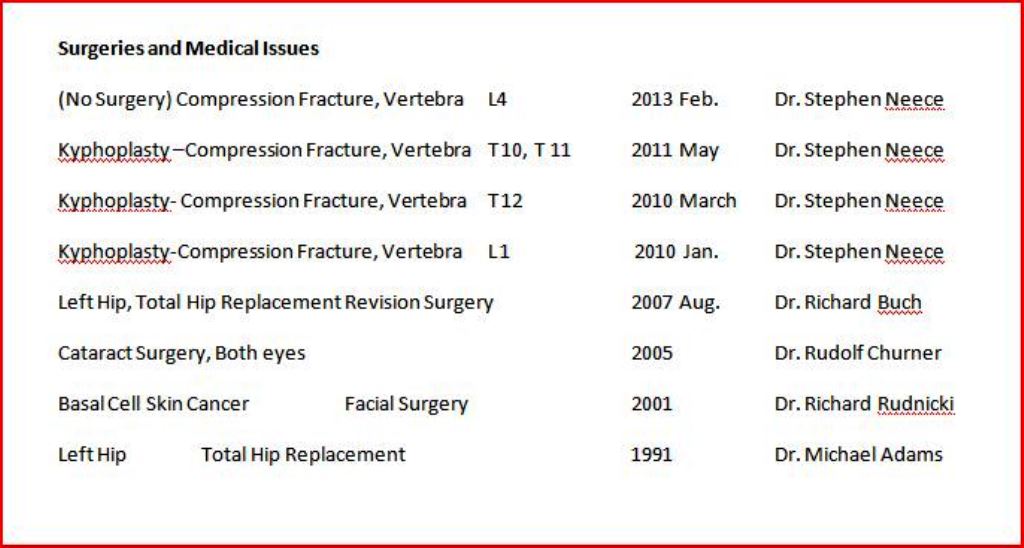
  • Prepare a List of previous surgeries, the types and the dates, such as,  Appendectomy - 1975; Left Hip, Replacement Surgery - 1991
It's a good idea to ask the patient for this information ahead of time. If they're confused or possibly unconscious you'll have the list available.


Most of the following items are optional for the Go Bag, but they're handy and easy to pick up at the dollar store.
  1. A small tablet for notes and instructions once the doctor arrives.
  2. A good book for long waits at the hospital and to avoid the germ laden, out-of-date magazines in the waiting room.
  3. Bottled water and packaged crackers or cookies. When your wait is long you'll be glad you have this. It never fails, if you leave the room for a minute to go to the cafeteria, that's when a medical person comes in with an update.
  4. Cup of instant soup or protein bars.
  5. Wet wipes and travel size hand sanitizer.
  6. Tissues for tears or runny noses.
  7. A new toothbrush and travel size toothpaste. This is for you.
  8. Packets of sugar or artificial sweetener, salt, pepper, and plastic spoons. Sometimes a vending machine has food but there are no utensils or condiments available.
  9. A clean pair of cotton socks to wear in those cold waiting rooms at the hospital.
If you drive your friend to the hospital, bring along any medical equipment they use. When Dad became critically ill after chemo, he refused to go in the ambulance. We drove him to the emergency room and in our haste, left his portable oxygen at home. The ER was overflowing and he had a dreadfully long wait before they finally admitted him to intensive care. Every gasping breath without his oxygen was a nightmare.

If your friend is admitted and you want to talk with the attending doctor,  sometimes they make their rounds near midnight so you could be waiting a while. Once you've invested hours waiting for X-rays, blood work and other stuff, you'll want to know what's going on.

In the hopeful possibility that your senior is not admitted, you'll want to bring their walker or wheelchair when you follow the ambulance to the hospital. They'll need these when they're released. One final tip just in case you lose the ambulance you're following. Ask the paramedics where they're taking the patient so you'll arrive at the right hospital.

Taking a few moments to assemble a few items into a Go Bag can reduce some of the anxiety that goes with any trip to the hospital. The best hope is that you won't ever need to use it.

Monday, February 27, 2017

On Becoming Your Parent's Guardian - Role Reversal


When our parents seek help on small tasks they've easily handled in the past, it can come as a surprise. The indecision creeps in slowly on little cat's feet starting with hesitation over making minor decisions about things they've handled effectively for years.

My mother asked, "How much rice goes in the pot and how long should I cook it?" I gently reminded her that she'd cooked rice for many more years than I had.

Small tasks became more difficult as time passed. In a way, being asked for advice from a parent was flattering. What I didn't know was that the tide had begun to turn; the child was becoming the parent one small step at a time.
Things went along smoothly as our new relationship emerged. I became more of an equal to someone who had always shown authority and control. This awesome responsibility is not to be taken lightly. It arrives with its own baggage, setbacks, and joy. Friends my age shared that they'd been also called upon to provide advice to parents.
My best friend shared the frustration she experienced when trying to persuade her mother to use her supplemental oxygen like she's supposed to. Another friend tried to convince her mother to use the hearing aide she clearly needs. She shared the frustration of constantly having to repeat herself to her mother. How familiar it seemed to be interrupted mid-sentence by someone who years ago said, "Not now, Mother is speaking." But the shoe is suddenly on the other foot.
Aunt Lou at 94
A stay-at-home mom of the fifties, my mother began her mid-life career with little or no employment experience. She left nurse's training to get married in 1945. After her thirty-year marriage ended, she took vocational training and embarked on a career as a Certified Nurse Assistant at the age of fifty.
Suddenly she asked for advice on dating, grocery shopping and apartment hunting, advice she'd provided me in the past. Mom's new life as a single, sole-provider spanned the next thirty years. Her experience of taking a job outside the home added skills, confidence and a sense of accomplishment. On her eightieth birthday, she officially retired from a second career as a Teacher's aide.
Reality struck when Mom went into the hospital for a month. Although I'd always been a co-signer on her checking account, it became my job to manage her bill paying. Looking over her checkbook register revealed a level of forgetfulness. There were unpaid insurance bills and past due notices tucked away in drawers.  Thankfully, Mom was glad to be rid of the responsibilities of balancing the bank account and paying the bills.
Driving soon became another challenge when she reached her eighties. With diminished reflexes and increased fragility, it was no longer safe for her to be behind the wheel. She no longer felt confident on the road anymore. It is the opposite of the day we first got behind the wheel of a car in our teens, a life-altering decision which makes a senior dependent on others for their basic needs to get to doctors' appointments, pick up groceries, or even visit a neighbor.

What a relief it was when she turned her car keys over without being asked. Not everyone is that practical when the time comes to stop driving and this can be a source of friction for concerned relatives.


The two sisters, well into their 90s, still functioned independently in so many important ways although living in a  skilled nursing home due to health, vision, hearing and memory impairments.

One thing remains certain in our relationship. It is the unshakable friendship of my Mom, my true friend. She is a blessing and reminds me in so many ways that I'm the lucky one. They both make me proud